
Loop: A solution to ensure the financial sustainability of microentrepreneurs
This case was developed by me and my group (Luísa Nunes, Mariana Chaves, Wellington Martins and Wilson Ulisses) during Tera's UX Design course, under the mentorship ofHenryk Slawski(currently Design Lead in the Dock). The project lasted two and a half months, from April to June 2021.
My performance: Product Designer
Technologies used:Miro, Figma and Google Forms

Context
At the beginning of the course, we received the following challenge:How to provide financial sustainability to the microentrepreneur.
To better understand this issue, we carried out a first survey about it, which proved not only the growth of micro-entrepreneurs in Brazil, but the importance that government institutions, such as Sebrae, are giving to their training.

Source:Government of Brazil
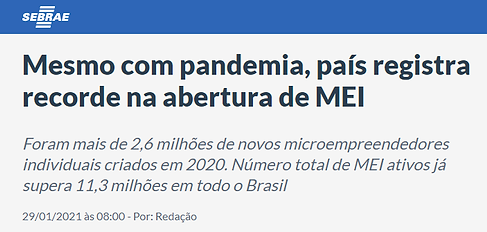
Source:Sebrae

Source:G1
With that in hand, some of the questions that arose were:What is the biggest difficulty (or difficulties) that micro-entrepreneurs face in maintaining their business? Who are? Which microentrepreneur most needs my help?
Search
In order to understand the behavior and pain of micro-entrepreneurs, a qualitative research was first carried out with ten people, ranging from twenty to fifty-five years old. We recruited them through advertising on social networks, most of them being contacts with known people. The criterion that all should follow was: undertake or have already undertaken. All interviews were conducted by telephone.
We identified some points of attention in therelationship between entrepreneurs and suppliers, as well as the direct impacts of this on the support of small businesses, which find it difficult to compete with larger brands due to price issues and relationships with those who supply what they need.

We then conducted a Google Forms survey with quantitative and qualitative questions to go deeper. 60 people answered the questionnaire.Note: In greater challenges and greater fears, respondents could give more than one answer.
In the quantitative questions, we have already identified a considerable diversity of challenges for micro-entrepreneurs, such as brand awareness, public loyalty, financial organization, supplier prices, partnerships with other companies, and bureaucracy.

To add more subsidies, we also asked what would be a good day and a bad day in their business. Good days, we got answers like “a day with a lot of sales”, “when I can prospect new clients”, “manage to close the proposal with the client” and “high productivity and many orders”. As for bad days, some of those that appeared were “when there are no sales”, “few customer service”, “few customers and few demands” and “tiredness”.

Then, we asked about the biggest fears, among which one caught our attention the most: Supplier price increases. We noticed a connection of this fear with two of the answers found in the question about microentrepreneur challenges and also with the qualitative research at the beginning.

In this way, we decided to filter out two issues to look at more carefully (the price of suppliers and the partnership with other companies).
Complement: Research with those who have already undertaken
Here, we also carried out this survey with people who had already started their own business, but closed their businesses, in order to understand the reasons that led to this decision, where the price of suppliers appears again. Of the 60 who responded to Google Forms, 12 are part of this group.

With the pandemic and the increase in people seeking their spaces to undertake, we understand that this growth is characterized by a greater number of people starting to undertake out of necessity, and not just by their own will. We also understand that, along this path, it is inevitable to needreliable suppliers, with affordable prices and easy communication, allowing the micro-entrepreneur to have a good profit marginand without having to charge such a premium compared to larger competitors.
After this research, we decided on the problem we would tackle and what our goal would be:FACILITATING THE RELATIONSHIP BETWEEN MICRO-ENTERPRISES AND SUPPLIERS.
Personas
As a reflection of research that pointed to diversity in microentrepreneurs' profiles, we arrived at multiple personas and filtered these three, with different sectors of activity, gender, age, behavioral characteristics and pains.


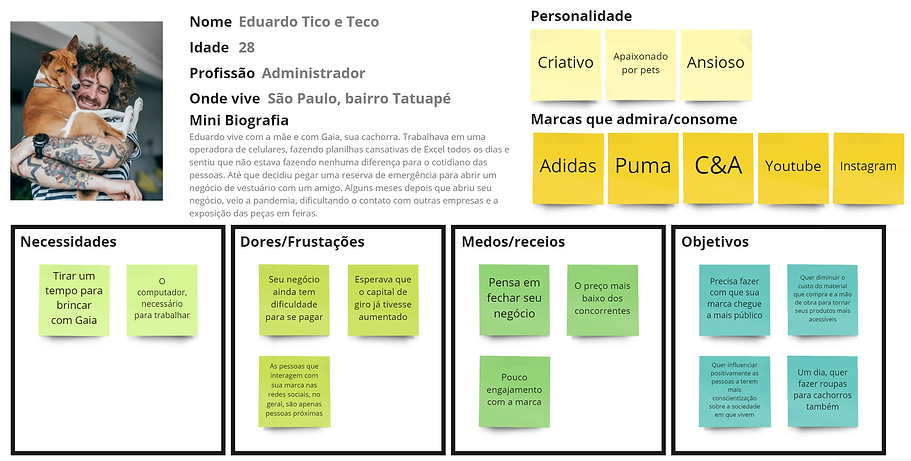
During the process, we made a dynamic to filter a main persona and developed an intersection diagram. In this way, Carlos was chosen to represent the microentrepreneur we are approaching, as he has more characteristics and pains in common with the other personas, which indicates a possible greater reach to other microentrepreneurs as well. Of points in common with Eduardo Tico and Teco, Carlos has: "Increasing margin", "Difficulty in beating competitors' prices", "Improving marketing" and "Getting good and cheaper suppliers". As for Martina Iniciante, along with Eduardo, the points in common are: "Improve your networking", "Attract new customers", "Pricing".

Diagram produced by the group
To remember, Carlos is 51 years old, he is a cook in BH and, despite having a lot of ambition to grow his business, he has difficulty promoting himself and being able to grow while maintaining his standard. For that, he needs to find better and cheaper suppliers that he can trust.

And now, how to solve?
Insights
Even with the objective and personas in hand, it still took us time to find a solution that made sense. We held Crazy 8s sessions and thought about; creation of a social network where micro-entrepreneurs could publicize their business; supplier mapping; chat for microentrepreneurs; course platform.

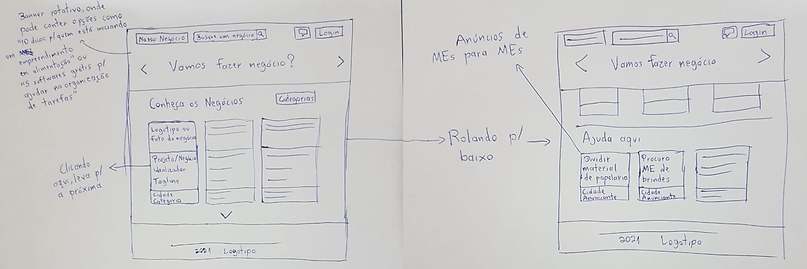


Images produced by the group
However, none of these ideas, in particular, were flowing well on their own, either because they were too complex for the time we had or because something was missing.
We remember our problem and what was the “how to solve it?”. At this point, we tested connections and combinations of some parts, such as easy communication with suppliers, mapping them (but in a simpler way) and adding business categorization. It was then that the solution took shape.
The solution
Now there's Loop, which is a platform designed to unite suppliers and entrepreneurs, like Carlos.

Images produced by the group
In it, Carlos manages to filter the types of suppliers he is looking for, either by categories, select one that catches his attention, either by evaluations or distance; learn more about that supplier and already be able to add items to the cart; simulate budgets and negotiate directly with the supplier in a safe space with credibility recognized by other micro-entrepreneurs.
The proposed solution creates arelationship of trust with the supplierand it makes it possible to negotiate better prices for products - factors directly linked to the micro-entrepreneur's PROFIT. It creates a network where the micro-entrepreneur does not have to do everything in a solitary and even exhausting process.
After a few months of use, a mapping is necessary to check how much the purchases generated benefits in the short/medium/long term and estimate a percentage of savings for the micro-entrepreneur.
Next steps
After a few months of use, a mapping is necessary to check how much the purchases generated advantages in the short/medium/long term and estimate a percentage of savings for the micro-entrepreneur, as well as the increase in their profit margin.
In addition, we identified points for improvement, both in usability tests and in the process findings. Are they:
-
Option to purchase products directly through the platform, so that the user can carry out all the processes in one place;
-
Periodic scheduling (weekly, monthly) of purchases, to automate and facilitate the process;
-
Visualization on a map of the location of suppliers, both for the user to know where this supplier is located and to know the place where he is buying from;
-
Accessibility refinement, so anyone can use it;
-
Desktop version of the platform.

usability test
Conclusion
After finishing this project, we discovered this matter:

Source:G1